
Common Management Interfaces, or CMIs, are essential to manage and monitor optic fiber modules. Transceivers are getting more complicated to accommodate increasing data rates and advancing network topologies. These standardized communication methods create a new layer of functionality, but are important for managing interoperability, diagnostics, and scalability for future development.
It extends far beyond traditional DOM (Digital Optical Monitoring) features and provides a far more detailed view into module behavior, link status, power settings, and configuration options. Originally developed to support the QSFP-DD (Quad Small Form Factor Pluggable-Double Density) form factor, CMIS has now become the go-to interface spec for many of the latest transceiver designs, including OSFP and beyond.
High-Speed Module Handling
One of the key reasons CMIS was developed was to address the sheer complexity and density of next-generation transceivers. The industry has moved on from 100G, 400G and now, 800G speeds, as the transceivers have developed. Digital signal processors, advanced thermal management and multiple lanes of data transmission have surpassed the extent to which legacy monitoring protocols could manage them, and CMIs became necessary.
CMIS allows host devices to interface with these high-speed modules in a way that’s modular, extensible, and reliable. It supports multi-lane operation, real-time signal health data, and module configuration profiles, all essential for keeping higher-speed links stable, especially in hyperscale and data center environments where dozens or even hundreds of these modules operate side by side.
Diverse Interoperability
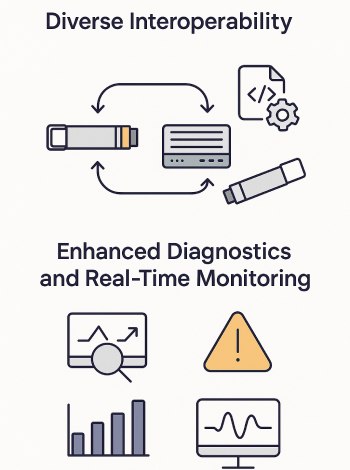
One of the challenges facing system architects has always been ensuring that transceivers from one vendor behave predictably in hardware from another. While Multi-Source Agreements (MSAs) helped standardize form factors and electrical interfaces, there was still a gap when it came to how transceivers actually communicate and share information.
CMIS closes that gap. It uses a standardized language and a set of management behaviors to allow greater interoperability between hardware from different vendors. A CMIs-compliant host system can also run detailed diagnostics on modules that support the same specifications, allowing network builders more flexibility and reduced market lock-ins.
Enhanced Diagnostics and Real-Time Monitoring
Traditional DOM provided basic monitoring features, transmit power, receive power, temperature, and voltage. But for modern networks running at 400G or more, that isn’t enough. Operators need insight into lane-specific performance, signal integrity issues, fault codes, and error logs. CMIS provides all of this and more.
Administrators can monitor individual lanes, and optical noise-to-signal ratios, or even set up alerts for module behavior to assess the system before any link fails occur. With a more insightful monitoring system in place, engineers don’t need to work by trial and error and guess the root causes; they can continuously analyse the system and avoid failures.
Versatility to Support New Form Factors
As the optical ecosystem continues to evolve, new form factors emerge to meet power, density, and speed requirements. OSFP and QSFP-DD are now common in 400G deployments, with 800G and even 1.6T transceivers beginning to appear. Each of these brings new thermal profiles, interface logic, and management demands.
CMIS is built to handle this diversity. Using modular structures, CMIs can handle the implementation of new hardware without breaking backward compatibility. Module resets, firmware updates, power adjustments and signal retimers are crucial to take on newer form factors and function reliably.
Enhanced Module Level Security
The more valuable and vulnerable the data, the higher the level of security needed. CMIs allow basic features through which host systems can identify, authenticate, and control optical modules with a greater degree of granularity.
A transceiver with CMI technology may add additional layers of security, such as encrypted configuration updates and tighter controls over which commands are permitted. Tracking inventory, enforcing firmware versions, and preventing unauthorized optics from infiltrating the network are all tasks this technology can perform, through which theft and losses are prevented.
CMIs For the Long Run
Arguably, one of the strongest arguments for CMIs is that they prepare networks for future developments and add scalability to current hardware. You gain access to the standardized management features and can roadmap a clear upgrade path as the transceivers evolve in what is a highly dynamic environment.
Through CMIs, the monitoring, automation scripts and language can be used across the entire optical layer, even if equipment or hardware is replaced. In the long run, it saves time both in terms of operations and troubleshooting, and gives the hardware an organic vision for future development.
Summarizing CMI-Enabled Modules
CMI is a solution for the increasing complexity and demands of modern optical networking. It standardizes the way hosts and transceivers communicate, unlocks diagnostic information, and makes way for system scalability in the future.
For network designers, integrators, and operators, picking CMIS-capable modules has stopped being a question of following the industry. It is about building smarter from the beginning, with visibility, compatibility, and scalability in mind.